"I don't think I can think of a time ever that Pinellas County has experienced the surge that we experienced." That was Pinellas County Sheriff Bob Gualtieri, describing the aftermath of Hurricane Helene in late September 2024, when storm surge topped six feet in St. Petersburg and pushed past seven feet on parts of the barrier islands. Hurricane Milton followed less than two weeks later, adding wind and rain damage to homes already gutted by Helene.
Two years later, the headlines about collapsed roofs and sand-buried streets have faded. What hasn't faded is the quieter shift those storms triggered in how much it costs to insure a house here, and that cost has stopped tracking the thing most buyers assume drives it: how close the home sits to the water.
The Zone Letter Is a Starting Point, Not an Answer
Every Pinellas County property carries a FEMA flood zone designation. Zone X, generally found inland in places like Largo, Seminole, and parts of Clearwater, means flood insurance isn't required for a mortgage, though it's still recommended. Zone AE, the standard 100-year floodplain, shows up often in Gulfport and Shore Acres, and requires flood coverage on any financed purchase. Zone VE, the coastal high-hazard category with wave action built into the math, covers barrier island stretches like Madeira Beach and Indian Shores, where building codes are stricter and premiums are highest.
That zone letter is where most buyers stop looking, and it's the wrong place to stop. Shore Acres sits in Zone AE, one tier below the most severe designation, yet more than 80 percent of homes there flooded across the two 2024 storms. The zone letter told buyers what FEMA's historical model predicted. The storms told a different story about what actually happens on the ground. Roughly half to 60 percent of Pinellas County addresses fall inside a FEMA Special Flood Hazard Area, and once you count moderate-risk Zone X, that climbs toward 75 to 80 percent of the county. In other words, almost nobody here gets to treat flood risk as someone else's problem, regardless of what the map's color coding suggests.
The Number That Actually Moves Your Premium
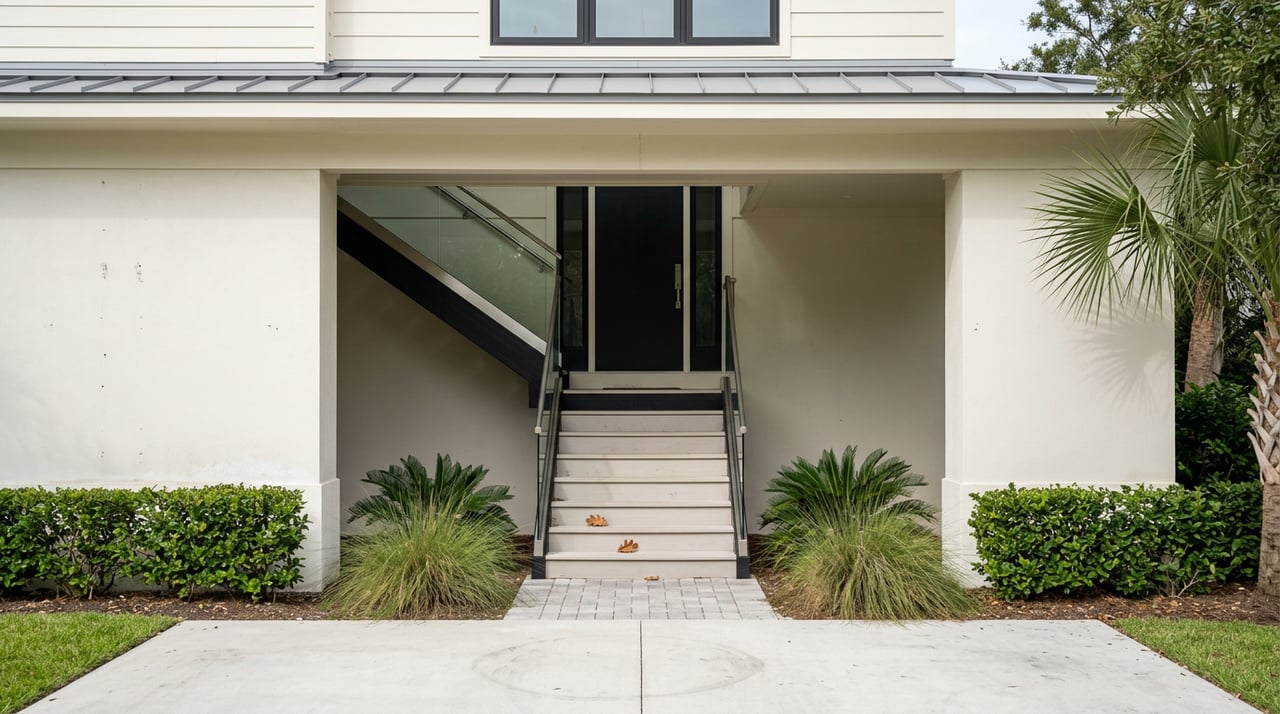
Since FEMA's Risk Rating 2.0 system took full effect, flood insurance pricing looks less at the zone letter and more at the individual property: elevation, foundation type, distance to water, and replacement cost. The single document that changes a quote more than almost anything else is the elevation certificate, which documents how high a structure sits relative to the Base Flood Elevation for its area. Two homes on the same Zone AE street, both built the same year, can price out very differently depending on whether one sits two feet above base flood elevation and the other sits at grade.
Getting your own certificate typically runs somewhere between $150 and $500 depending on the surveyor and the property, and it's worth doing before you write an offer, not after. A homeowners policy on a typical Pinellas County single-family home currently runs roughly $3,900 to $5,500 a year with wind coverage included. Flood coverage sits on top of that as a separate policy, adding $1,200 to $3,000 or more depending on zone and elevation, with barrier island VE-zone premiums commonly running $3,000 and up on their own. The National Flood Insurance Program also caps residential coverage at $250,000 for the structure and $100,000 for contents, so many higher-value waterfront homes need a private flood policy layered on top to cover the gap. Florida has allowed private flood policies to satisfy lender requirements since 2019, which gives buyers more room to shop than the NFIP-only market of a decade ago.
Why a City Nobody Calls Glamorous Just Became the Interesting Story
Here's where the zone-letter shorthand really breaks down. Pinellas Park, an inland city with none of the beachfront cachet of Clearwater Beach or Madeira Beach, just earned a Class 5 rating through FEMA's Community Rating System, a designation based on how aggressively a community manages its floodplain rather than how far it sits from the Gulf. That rating unlocks a 25 percent discount on NFIP flood premiums for eligible residents starting October 1, 2026, according to reporting from Bay News 9. Pinellas County as a whole already holds a strong enough CRS classification to give residents up to a 40 percent discount on flood premiums, one of the more meaningful structural cost breaks unique to the county. But the size of that discount varies by city, because it's earned through local floodplain management practices, not simply granted for being Florida coastal property.
Meanwhile, rate movement across the county isn't following the "beach costs more" script either. Some barrier island and bayfront pockets are seeing relief while others are seeing increases, largely independent of home price or postcard appeal. The practical takeaway: a city's insurance trajectory is now its own variable, separate from its median price and separate from its distance to the Gulf. Comparing two Pinellas neighborhoods by price per square foot alone tells you nothing about which one is about to get cheaper, or more expensive, to insure.
What This Means If You're Comparing Neighborhoods by Price Alone
| Area type |
Typical flood zone |
What actually drives the insurance number |
| Largo, Seminole, inland Clearwater |
Zone X |
Flood coverage optional for most mortgages, but roughly 75 to 80 percent of the county still carries some mapped flood risk once shaded Zone X is counted |
| Gulfport, Shore Acres |
Zone AE |
Required for financed homes; real-world flood history (Shore Acres) can outpace what the zone letter implies |
| Madeira Beach, Indian Shores |
Zone VE |
Highest base premiums, strictest building codes, but individual elevation still swings the actual quote |
| Pinellas Park |
Mixed |
City-level CRS Class 5 status cuts NFIP premiums 25 percent starting October 1, 2026, regardless of the underlying zone letter |
Look at the Clearwater Beach submarket as a case in point. As of the most recent data available in July 2026, the median sale price there sat near $725,000, down 17.6 percent year over year, while nearby Sand Key held closer to $999,000 for premium Gulf-front condos, Island Estates ran around $629,000 as a more affordable and family-oriented pocket, and North Beach's newer developments traded closer to $850,000. Those price gaps look like the whole story on a portal search. They aren't. A buyer choosing between a $629,000 home in Island Estates and a $725,000 home elsewhere in Clearwater Beach needs an actual bound insurance quote for each address before deciding which one is really the better monthly payment, because the price difference and the insurance difference don't move in the same direction.
The Disclosure Rule Changed Too
Florida's flood disclosure law, House Bill 1049, took effect October 1, 2024, and requires sellers to tell buyers in writing, before the sales contract is signed, whether they've filed a flood insurance claim or received federal flood assistance for the property. A 2025 expansion broadened that further, requiring disclosure of any flooding that damaged the property, not just flooding tied to a filed claim. For a buyer in Pinellas County, that means the paperwork now carries more of the property's real flood history than it did before 2024, which is one more reason to read it carefully rather than treat it as boilerplate.
A Few Questions Worth Asking Before You Write an Offer
Does a lower flood insurance quote mean a house is genuinely safer?
Not necessarily. A discount from a city's CRS classification, like Pinellas Park's new 25 percent break, reflects floodplain management scoring, not a change in the physical risk to that specific parcel. Pair a good citywide rating with your own elevation certificate before drawing conclusions.
If I'm paying cash, do I still need flood insurance?
Lenders won't require it without a mortgage, but with 50 to 60 percent of Pinellas County addresses in a FEMA Special Flood Hazard Area, skipping the coverage is a real financial bet, not just a paperwork shortcut.
What if the seller says the home never flooded?
Ask for the written flood disclosure required under Florida law and read it against any elevation certificate on file. Since the 2025 expansion, sellers must disclose flooding history even when no insurance claim was ever filed.
Comparing Pinellas County neighborhoods on price alone will always miss the number that actually determines what you can afford to carry each month. Flood insurance in this county now moves on its own logic, shaped by elevation certificates, city-level floodplain scores, and disclosure history that a listing price can't show you.
If you're weighing a move between Gulfport and Largo, or trying to figure out whether a Clearwater Beach condo or an Island Estates home fits your real budget, The Waugh Group can walk the zone maps, elevation data, and current insurance landscape with you before you write an offer. Schedule a free consultation or request a home valuation to start with numbers specific to the address you're actually considering.